tigerexped GmbH & Co. KG

By selecting "Accept all", you give us permission to use the following services on our website: Strictly necessary cookies, YouTube, ReCaptcha, Matomo web analytics, Brevo. You can change the settings at any time (fingerprint icon in the bottom left corner). For further details, please see Individual configuration and our Privacy notice.
Legals/Imprint | Privacy PolicyThe settings you specify here are stored in the "local storage" of your device. The settings will be remembered for the next time you visit our online shop. You can change these settings at any time (fingerprint icon in the bottom left corner).
For more information on cookie lifetime and required essential cookies, please see the Privacy notice.
Strictly necessary cookies are those that enable the basic functions of a website. Without them, the website will not work properly.
To view YouTube contents on this website, you need to consent to the transfer of data and storage of third-party cookies by YouTube (Google). This allows us to improve your user experience and to make our website better and more interesting. Without your consent, no data will be transferred to YouTube. However, you will also not be able to use the YouTube services on this website.
Embedding videos
Processing company:Google Inc.
Terms of use: https://policies.google.com/privacy?hl=enTo submit forms on this page, you need to consent to the transfer of data and storage of third-party cookies by Google. With your consent, reCAPTCHA, a Google service to avoid spam messages via contact forms, will be embedded. This service allows us to provide our customers with a safe way to contact us via online forms. At the same time, the service prevents spam bots from compromising our services. After you gave your permission, you might be asked to answer a security prompt to send the form. If you do not consent, unfortunately you cannot use the form. Please contact us in a different way.
Stopping spam bots
Processing company:Google Inc.
Terms of use: https://policies.google.com/privacyMatomo is our self-hosted web analytics (server in Germany, hosted by netcup GmbH). With your consent, page views, referrers, device information as well as cart and orders are recorded for statistics (cookies _pk_id 13 months, _pk_ses 30 minutes, _pk_ref 6 months). IP addresses are truncated; the data is not shared with third parties. Withdraw at any time via the cookie settings.
Audience measurement and e-commerce statistics
Processing company:tigerexped GmbH & Co. KG (Matomo selbst betrieben auf analytics.tigerexped.de, Hosting: netcup GmbH)
Terms of use: https://www.tigerexped.de/privacy-policyTo send data to Brevo, you need to consent to the transfer of data and storage of third-party cookies by Brevo. This allows us to improve your user experience and to make our website better and more interesting.
Brevo Automation Tracking
Processing company:sendinblue
Terms of use: https://sendinblue.com/legal/privacypolicy/Would you like to see these contents? Activate the desired contents for one session only or allow the website to remember these settings. Once you have given your consent, the third-party data can be loaded. For this, third-party cookies might be stored on your device. You can change these settings at any time (fingerprint icon in the bottom left corner). For further details, please see the Privacy notice.
Many solutions in camper conversions seem obvious today. You pick a technically mature product, install it - and it works. What often gets overlooked: the road to get there was usually long and shaped by individual, isolated solutions.
Travel vehicles, however, are not a collection of individual components but complex technical systems. Heating, power supply, water system and comfort features have to work together reliably over the long term under changing conditions.
Our approach at tigerexped is to put exactly this interplay at the center. We look at components in the context of the entire vehicle and keep developing wherever ease of use, safety and efficiency can be improved through design in a meaningful way.

Some solutions exist in principle. Hot water without extra energy use via the auxiliary heater, for example.
With some research, patience and a joy of improvising, the devices available on the market - auxiliary heater and boiler - could be combined with each other.
But not everyone gets fully absorbed in building out their vehicle, enjoys researching or likes to experiment for long. Understandably, for many people the focus is on traveling - not on the build itself.
On top of that: without properly matched components and clear instructions, mistakes kept occurring that led to malfunctions - especially with the heater.
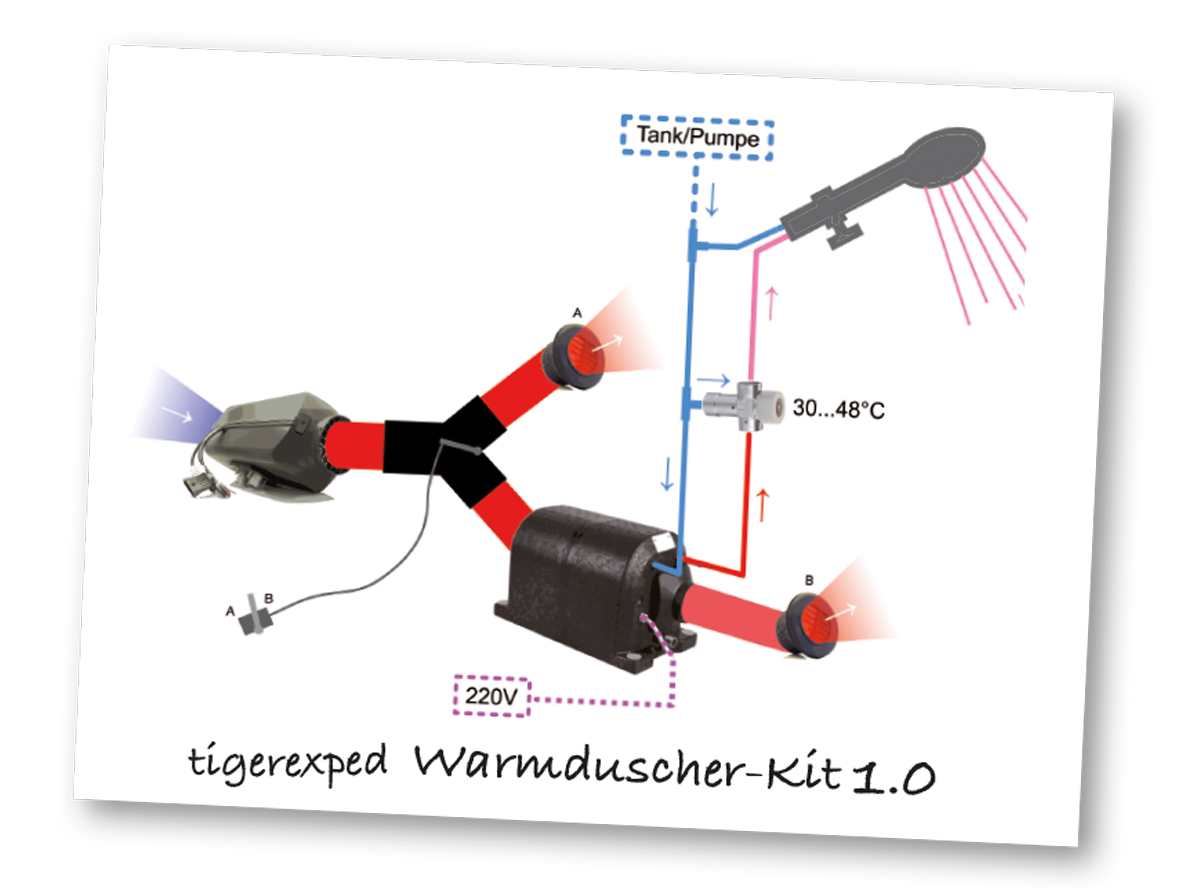
The goal was therefore to make individual research unnecessary and to rule out typical sources of error by design. Instead of individual combinations, a well thought-out solution was to emerge that is easy to implement and works reliably. This is how the Hot Shower Kit came about - a matched complete system including easy-to-follow instructions.
Such complete systems of heater and boiler have since become established in the scene. The term "Hot Shower Kit" is also used across manufacturers for comparable solutions.

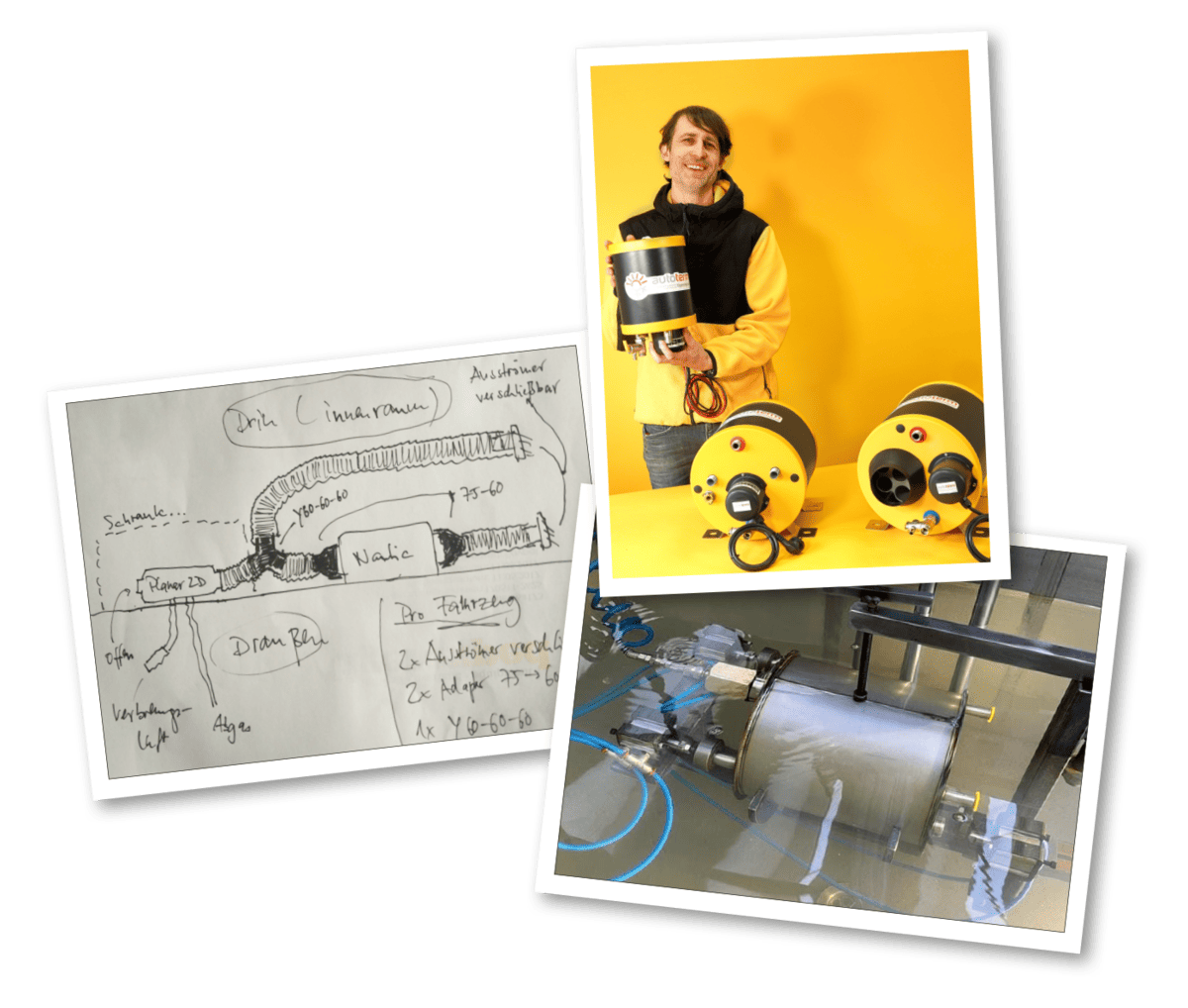
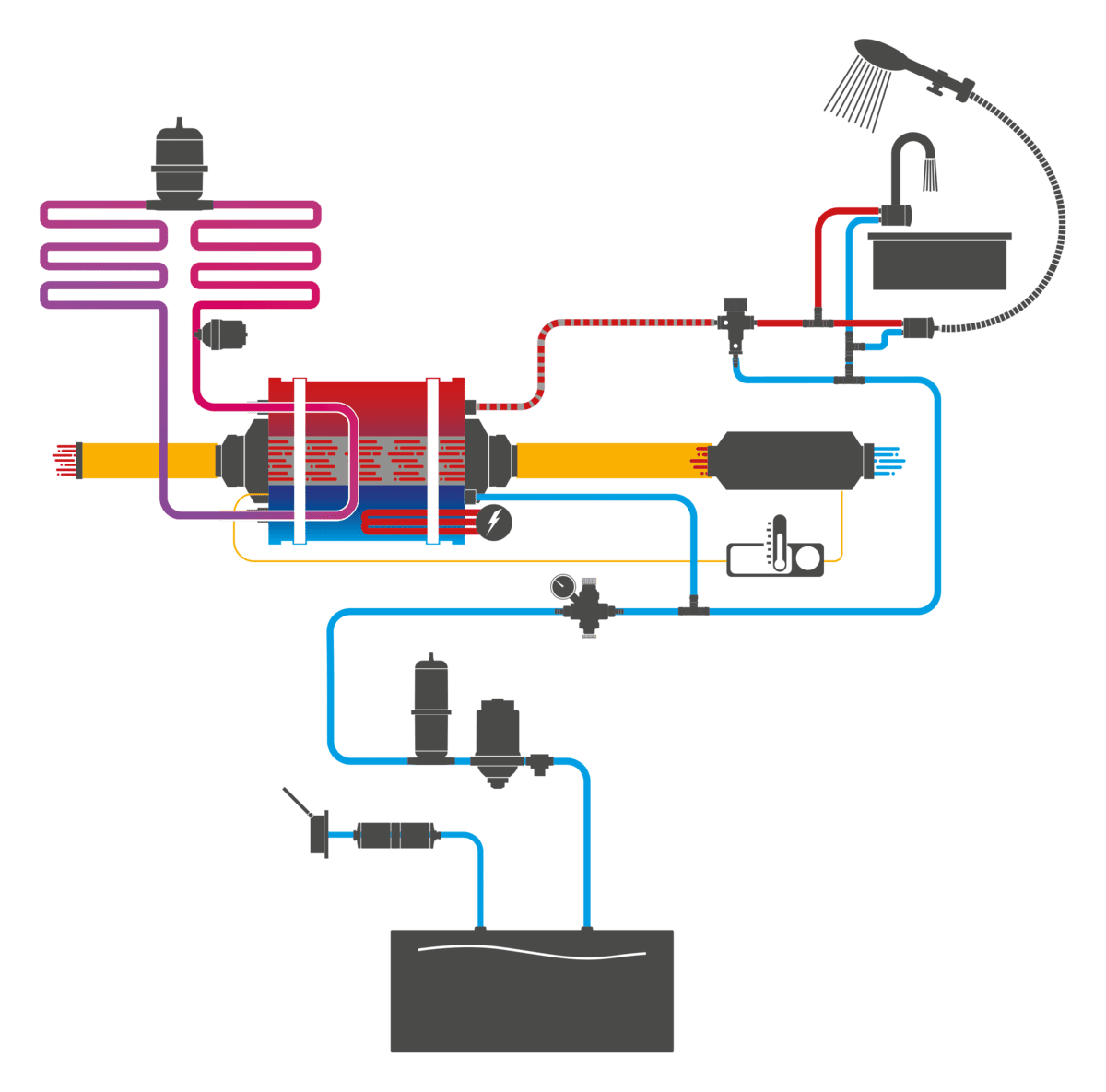
Especially with the hot shower topic, it became clear that many of the boilers available on the market had room for improvement in certain respects - including the safety of the installation.
To develop these aspects further in a targeted way, we designed our own boiler and built the experience of many years of use into it. A key role is played by the flow optimization of the warm air routing, which prevents the auxiliary heater from overheating. As a result, the boiler can now also be used in combination with a 4 kW heater - a setup that was previously considered critical because of thermal load.
There are numerous other design adjustments that work in the details. Many of them remain hidden - like the flow optimization itself. They do, however, help the system work reliably over the long term and be comfortable to use in everyday life.

We applied the principle of building installation know-how directly into a product not only when developing kits, but also with our own new developments. This is how a central electrical unit came about, in which experience from many years of practice was put into the design. Consistently following functional requirements inevitably led to a form that differs clearly from classic electrical components.
What matters most, however, is the underlying electrical layout: the structure of the overall system was built into the product by design. Typical installation mistakes are avoided from the outset, since power distribution, fusing and connection logic are clearly defined. The much smaller room for interpretation this creates results in a clearly defined and easy-to-follow wiring layout.
Besides simpler wiring and lower system complexity, space requirements and thermal load - for example from bundled, warm cables in tight cable ducts - are also addressed by design.

Similar to the further development of the boilers, an eye for certain details has also accompanied us for years when it comes to energy.
For solar systems, one figure was long the main focus: the rated power. 200 Wp was 200 Wp - regardless of how large the panel was, how efficient the cells were or how strongly heat affected the actual yield.
In practice, however, it turned out that this view alone is not enough. Factors such as the general voltage level, the cell efficiency for more power per area, the temperature coefficient and the behavior under partial shading are just as important. These parameters largely determine how much energy is actually available under real conditions.
Size also played a role. Our range deliberately includes panels with comparatively compact dimensions. The reason is damage prevention: on poor roads, smaller formats are less prone to microcracks caused by vibration. Vehicle owners who had previously used large-format panels from the home sector mostly understood these relationships well.
Today these technical details are taken into account much more - both in product selection and in communication. Our early focus on these parameters helped to make their importance more visible in the market. Not out of trend, but because they are decisive for actual performance.

The same principle applies to the vehicle's electrical system. Many modern devices can only be run in a camper via an inverter - with the corresponding conversion losses, additional hardware and increased system complexity.
An alternative approach is to provide high charging power directly from the 12 V system. For this we developed a USB-C charger with a buck-boost converter that delivers up to 100 W stably from the vehicle's electrical system - without the detour via 230 V.
Hardly distinguishable from a conventional USB-C socket on the outside, this solution reduces energy losses and simplifies the vehicle's electrical structure.

All these developments have a common denominator: they stem from the aim of making technical solutions functional, robust and durable in practice.
That also means that design quality, safety margins and well thought-out system integration take effort. Not every solution can be optimized for the lowest price.
Travel vehicles are complex technical systems that have to work under changing and often demanding conditions. For many owners, time with their vehicle is limited, planned long in advance and valuable accordingly. Technical failures or limitations directly affect this time, which results in special demands on the reliability and function of the installed components.
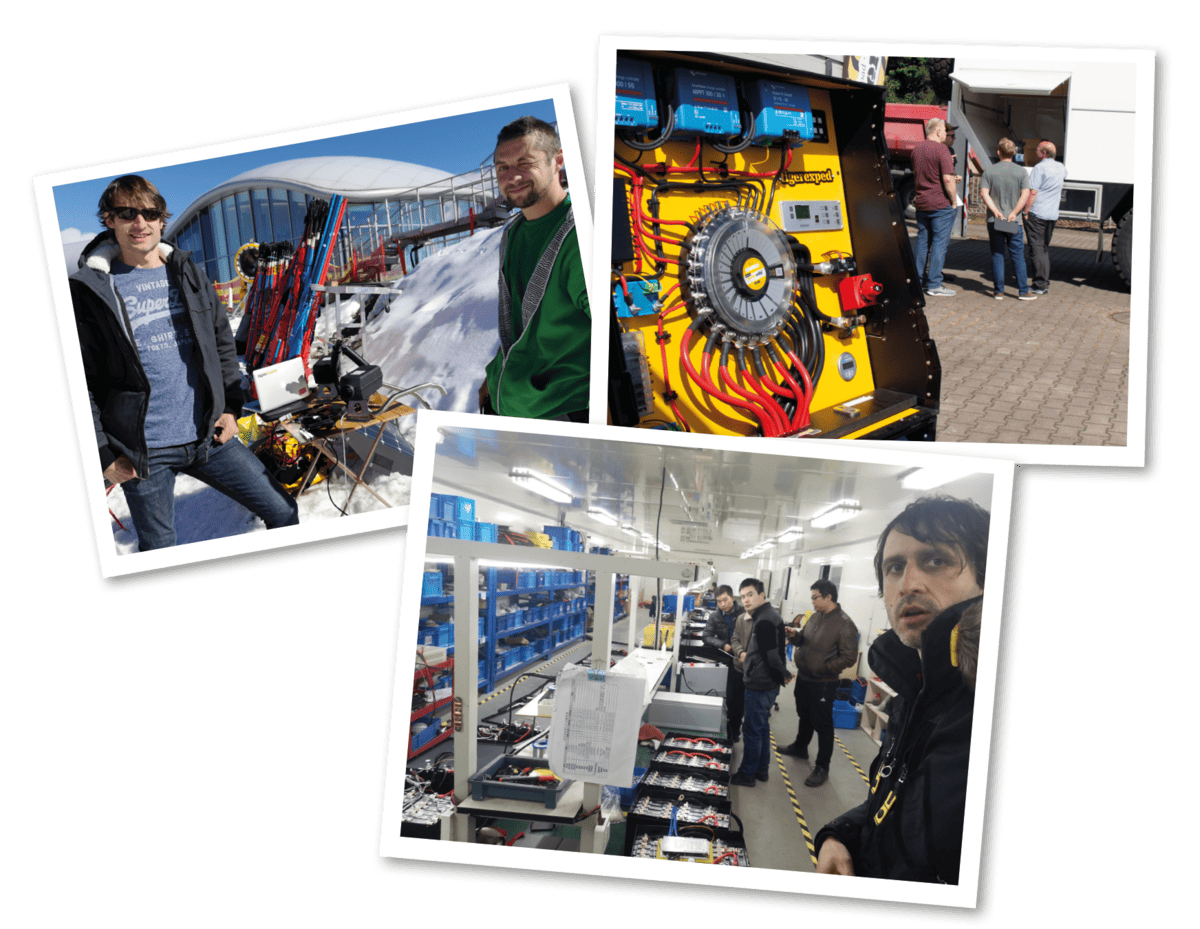

We will keep questioning, optimizing and developing in the future - not on principle, but where it makes technical sense. The aim is systems that are clearly structured, can be operated reliably and hold up over the long term.
That is how we started.
On this foundation we keep developing.
