Charging from Shore Power

Charging from Shore Power
Mains hook-up lets you recharge the leisure battery in your camper van or motorhome at a campsite, motorhome stopover or at home. Here you’ll find battery chargers, combination units, shore power inlets and cables. Your choice depends on battery type, system voltage and the charging output you need – and whether you also want to run 230 V appliances away from mains power.
What do you need to charge from mains hook-up?
Mains hook-up, also known as shore power, supplies your vehicle with electricity from an external connection. To use this energy to charge your leisure battery, you need a suitable battery charger. It converts the incoming AC voltage into the appropriate DC voltage and controls the charging process.
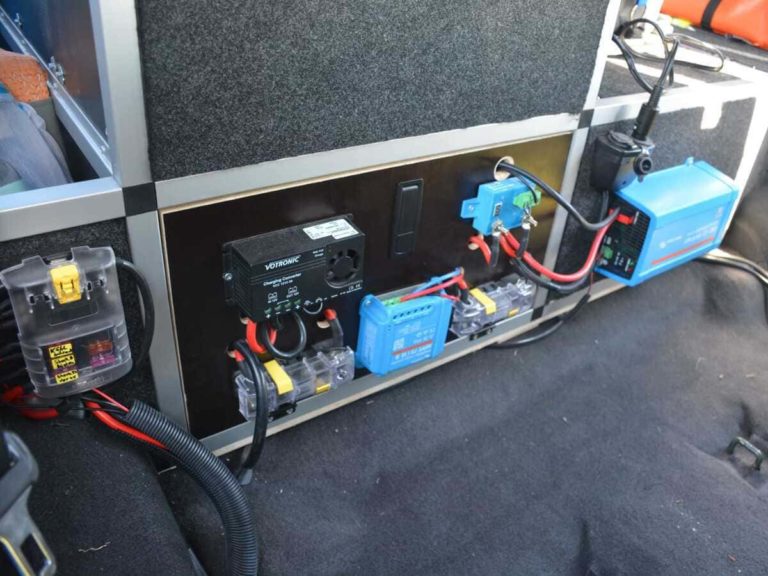
The vehicle’s shore power inlet and hook-up cable provide the connection to the external power source. They do not replace a charger. A standalone inverter does not charge your battery either: it converts battery power into a 230 V supply. An inverter/charger combination unit performs both functions.
A separate battery charger: when you want to recharge your battery
A mains battery charger is the right choice if you want to charge your leisure battery from an external power source. It can complement an existing installation and works whether or not you also use solar or a DC-DC charger for alternator charging.
The main selection criteria are battery voltage, supported battery types and charging current. If a charger is already integrated into your vehicle’s electrical distribution unit or another system component, check its capabilities first. You may be able to configure it appropriately rather than install an additional device.
An inverter/charger: when you also want 230 V power without mains hook-up
An inverter/charger combination unit performs two jobs: with mains hook-up connected, it charges your battery; without mains power, it runs suitable 230 V appliances from the battery. Models with an integrated transfer switch can supply the connected circuits from either mains hook-up or the inverter, depending on the operating conditions.
This is useful if you want to run a coffee machine, kitchen appliances or a mobile workspace away from a mains connection. Compare two separate specifications: inverter output determines which 230 V appliances you can run, while charging current determines how quickly the unit can replenish your battery. The battery and installation must also support the inverter output you intend to use.
Battery voltage and chemistry: What must the charger support?
The charger’s output voltage must match your leisure battery system. A 12 V installation needs a suitable 12 V charger, while a 24 V installation requires a corresponding 24 V model. A “230 V” specification, on the other hand, usually refers to the mains voltage on the input side.
Also check for a charging profile suitable for your battery, such as LiFePO4, AGM or gel. Adjustable charging parameters can be useful if your battery has specific requirements. What matters is whether the charger provides the required charging voltages and current limits, rather than simply carrying a “lithium compatible” label.
If you replace an existing lead-acid battery with LiFePO4, your mains charger therefore needs checking too. Also check how charging will be kept within the battery’s permitted temperature range.
Charging current: How quickly do you need to recharge?
A higher charging current can reduce charging time. However, it must suit your battery’s capacity and permitted charging current. If you regularly connect overnight, your requirements may differ from those of someone who wants to replenish as much energy as possible during short stops.
As a rough guide, replacing 60 Ah at a constant current of 20 A flowing into the battery would theoretically take three hours. In practice, it can take longer, for example because charging current decreases towards the end of the charging cycle or because appliances are running at the same time.
Allow for your consumption while charging. If the charger supplies 20 A and your DC appliances use 5 A of that output, approximately 15 A remains to charge the battery. If several charging sources operate simultaneously, their potential combined charging current must also stay within the battery’s limits.
One or more charging outputs: How many batteries do you want to charge?
One suitable charging output is normally enough for a single leisure battery or a battery bank operating as one unit. Multiple outputs can be useful for charging separate batteries, such as a leisure battery and a starter battery.
Check exactly how the outputs work: some chargers share a total charging current across several outputs, while others have a separate, lower-current output for maintaining the starter battery. Three charging outputs therefore do not automatically mean three times the stated charging current.
Multiple terminals do not necessarily allow you to charge different battery chemistries together either. The key question is whether the outputs can be configured independently or all use the same charging profile.
Limited campsite power: How does it affect your choice?
A campsite or motorhome stopover may not provide all the power your vehicle could potentially use. The battery charger and any 230 V appliances running at the same time share the available supply. A kettle or heater can already account for a substantial part of it.
Importantly, charging current on the battery side is not the same as current drawn from the mains connection. A charger with a 30 A output does not require 30 A from a 230 V socket. Its AC input power or current draw determines how much of the available mains supply it uses.
Adjustable charging current can help reduce the charger’s power consumption. Selected inverter/chargers also offer an adjustable shore power current limit and adapt battery charging to the power remaining after other loads are supplied. Models with a power-assist function can draw additional energy from the battery when demand increases. These features vary by model and are worth considering when choosing your system.
Shore power inlet and cable: What works together?
Your charger needs a suitable connection between the external power source and the vehicle. When selecting the inlet, cable and connectors, check their rated voltage, current capacity, physical compatibility and suitability for the installation environment. Similar-looking connectors are not necessarily compatible.
This category also includes connections for different electrical systems. A 125 V model, for example, is not a substitute for a suitable 230 V shore power inlet. A plug adapter changes neither voltage nor frequency. If you travel beyond areas with a standard 230 V supply, your charger’s permitted input range must also match the available power source.
Check what is included as well: a charger supplied with a mains plug does not automatically include a vehicle shore power inlet or an external hook-up cable. The fixed 230 V installation and its protective measures should be installed and tested by a qualified electrician.
Installation and operation: What matters in everyday use?
Allow for the unit’s dimensions, cable connections and specified cooling clearances when planning the installation. Its ingress protection rating must suit the location; not every charger is suitable for damp conditions or an exposed mounting position.
If the charger is installed near your bed, fan noise may also matter. Some chargers offer a quiet operating mode with reduced charging output. Depending on the model, Bluetooth, an external display or integration into a monitoring system can make configuration and checks easier, particularly when the charger is installed somewhere difficult to access.
What to compare before buying
- Required functions: Do you only want to charge your battery, or also run 230 V appliances without mains hook-up?
- Battery compatibility: Do the output voltage, charging profile and charging current suit your leisure battery?
- Charging time and consumption: How long do you normally stay connected, and which appliances run while charging?
- Charging outputs: Do you want to charge one battery bank or several separate batteries?
- Mains connection: Do the input voltage, power consumption, vehicle inlet and hook-up cable suit your intended use?
- Installation and operation: Are the available space, cooling and ingress protection suitable, and which monitoring features do you need?