





Solar Charge Controllers
Solar Charge Controllers
A solar charge controller connects your solar panels to your leisure battery and manages charging. Here you will find MPPT controllers for your camper van’s solar setup – depending on the model, with Bluetooth, system communication or an additional starter battery maintenance charging output. Choose according to your panel specifications, battery requirements and the features you need.
Which solar charge controller suits your system?
A suitable solar charge controller needs to connect two sides: the solar panels at its input and your battery at its output. The total wattage of your array is therefore only part of the picture. Panel voltage, panel current, battery voltage and the required charging current also matter.
Check these electrical requirements first. Then decide whether you want to view your solar readings on your smartphone, integrate the controller into central monitoring or also maintain your starter battery.
What does an MPPT solar charge controller do?
A solar panel’s output changes with sunlight, temperature and shading. During operation, an MPPT controller tracks the operating point at which the connected panels can deliver the most power. MPPT stands for “Maximum Power Point Tracking”.
The controller converts solar energy into a charging output suitable for the battery. This allows you to use panels with a considerably higher voltage than the battery, provided they remain within the controller’s permitted input limits. The charging settings must match the specific battery type.
Check system voltage and battery type first
Choose a controller that supports your leisure battery’s nominal voltage. Not every model is suitable for all 12, 24 or 48 V systems. The permitted solar array power may also differ depending on the battery voltage.
LiFePO4, AGM, gel and flooded batteries require suitable charging profiles. Automatic system voltage detection does not automatically mean that the battery chemistry is detected too. Check and configure the charging profile before use.
With lithium batteries, you also need to consider the permitted charging currents and temperature limits. If the controller is to limit or stop charging according to battery temperature, check how that temperature is measured and whether an additional sensor or compatible data connection is required.
Panel voltage: stay below the limit even in cold conditions
Your panels’ open-circuit voltage is particularly important for the solar input. When panels are connected in series, their voltages add together. Because open-circuit voltage rises in cold conditions, comparing values under standard test conditions alone is not enough. The array must remain within the permitted input voltage even at the lowest temperatures you expect to encounter.
At the same time, the controller needs a sufficiently high solar voltage to start and continue operating. Alongside the maximum input voltage, check its required operating range. This is particularly important with higher battery voltages and single-panel setups.
Charging current and solar power: what size controller do you need?
The maximum charging current describes how much current the controller can supply on the battery side. It is not the same as the current on the panel side. Through voltage conversion, the charging current flowing to the battery can be higher than the current supplied by the panels at the input.
For Victron SmartSolar controllers, for example, “75/15” indicates a maximum PV open-circuit voltage of 75 V and a maximum battery charging current of 15 A. These numbers do not describe panel output in watts.
Also compare the solar array power specified for your battery voltage and the maximum permitted PV short-circuit current. When panels are connected in parallel, their currents add together. All relevant limits must suit the planned array.
A larger controller does not automatically generate more energy from the same panels. It can, however, make sense if you plan to expand your array. Equally, you cannot connect unlimited additional panel power to every controller: any oversizing of the array must be explicitly permitted and remain within the specified voltage and current limits.
Victron SmartSolar: Bluetooth and a choice of power ratings
Victron SmartSolar controllers are worth considering if you want to check your solar readings conveniently on your smartphone and configure charging through the VictronConnect app. Bluetooth is built in. The range offers different combinations of permitted panel voltage and maximum charging current.
If you use or plan to install central Victron system monitoring, check the interfaces on the specific version. Connections and features can also vary within the range. SmartSolar controllers do not include an additional starter battery charging output.
Votronic: starter battery maintenance and integration with your vehicle’s electrical system
Alongside leisure battery charging, the Votronic MPP 170 CI offers an additional starter battery maintenance output providing up to 1 A. This can be useful when your vehicle is parked for extended periods and sufficient solar energy is available. However, the secondary output does not replace a powerful charger for a discharged starter battery.
Connections are available for compatible Votronic displays and a Bluetooth Connector to display solar readings. Bluetooth therefore requires an accessory with this model. If you want to retain an existing electroblock or display, check the specific compatibility and the connecting cables required.
Renogy REGO: solar charging with Bluetooth and RV-C
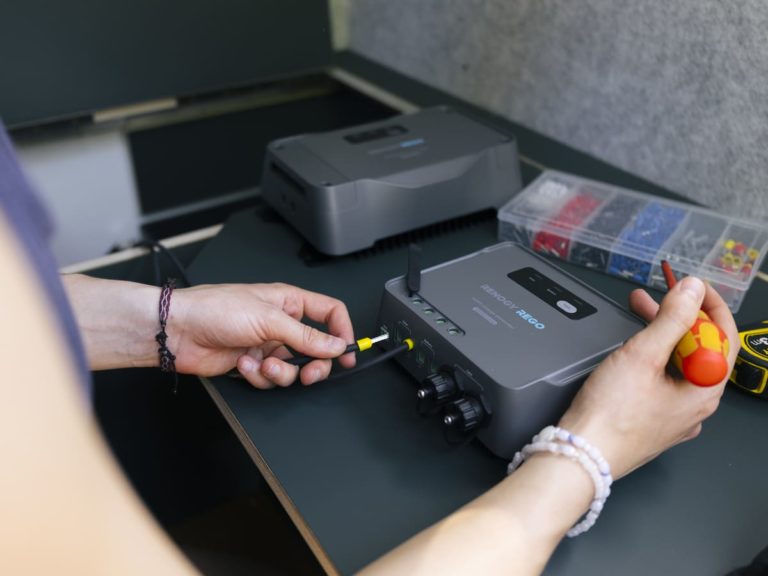
The Renogy REGO 30 A MPPT controller is designed for 12 and 24 V battery systems and offers Bluetooth and RV-C communication. It is worth considering if you want a standalone solar controller with app connectivity or plan to integrate it into a compatible Renogy system.
As with other controllers, solar array power, input voltage and battery settings must suit the system. For central monitoring, your specific devices also need to be able to communicate with one another. An interface name alone does not guarantee full interoperability.
Separate solar controller or combination unit?
A standalone solar charge controller is a good fit if you want to install or expand solar charging independently of your other charging sources. You can size it specifically for your panels and replace it separately later.
If you are also planning alternator charging or other functions from scratch, a device with an integrated MPPT controller may make sense. Options include DC-DC chargers with a solar input and more comprehensive power management systems. You will also find suitable solutions under combination units.
Compare the solar input limits separately. A high amp rating in a combination unit’s name does not automatically mean that the full current is available through solar charging. Simultaneous use of several charging sources also depends on the model.
Understanding monitoring and the load output
A solar controller’s display shows what the solar array is currently producing or has generated over a period of time. It does not automatically replace a battery monitor that measures all charging and discharging currents for your leisure battery. Solar output alone cannot reliably tell you how much energy remains in the battery.
Some controllers also have a load output, often labelled “Load”. This should not be confused with a second battery charging output. Whether you can connect an appliance to it depends on the appliance’s operating current, start-up current and the controller’s requirements. Powerful appliances such as inverters must not be connected to this output without explicit approval for that use.
Plan for installation and future expansion
A solar charge controller needs a suitable installation location with adequate heat dissipation. Allow for the specified mounting orientation, clearances and space for cable connections. Cable cross-sections and circuit protection must suit the system; unnecessarily long cables to the battery can cause additional voltage drop.
If you want to add more panels or a folding solar panel later, consider their electrical specifications when choosing your controller. For different groups of panels, a dedicated MPPT controller can be more suitable than connecting everything to an existing controller.
Compare these details before buying
- Battery: Which system voltage, battery chemistry, charging settings and current limits need to be considered?
- Solar panels: What total power, open-circuit voltage and short-circuit current result from the planned wiring arrangement?
- Controller rating: Are the PV input limits, operating range and maximum battery charging current suitable?
- Features: Do you need Bluetooth, integration with central monitoring or starter battery maintenance charging?
- Installation and expansion: Have you allowed for mounting space, wiring and possible future additions?