





Heat Water
Heat Water
Hot water for showering, washing up and washing your hands: here you’ll find water heaters, heating systems and suitable connection accessories for your camper van or motorhome. Whether you use electricity, warm air from your diesel heater or engine heat, the right solution depends on your hot water needs and the energy sources available on your travels.
Which hot water system is right for your camper van?
Start with the way you travel: do you drive regularly, often stay on sites with shore power, or spend several days without an external power supply? Also consider whether you only need small amounts for washing your hands and doing the dishes, or want to shower regularly in your vehicle. This will help determine the right heating method, the amount of water you need and the demands on your energy system.
monoBOIL: for electric water heating
The monoBOIL heats water exclusively through an electric heating element. It’s a suitable choice if you want a standalone hot water solution without connecting it to an air heater or the engine coolant circuit.
Choose the electrical version to match your power supply: a 12 V or 24 V model can run from the corresponding onboard electrical system. A 230 V version requires shore power or a suitably sized inverter. What matters is not just whether the connection is available, but whether your battery and charging sources can cover the additional energy demand.
duoBOIL: for using engine heat while driving
The duoBOIL combines an electric heating element with a coolant heat exchanger. When connected appropriately, it can use waste heat from the engine to heat water while you drive. This is particularly useful if you move frequently and want hot water when you arrive.
Electric heating remains available during longer stays. Plan how you’ll heat your water when the engine isn’t running. Integration into the engine coolant circuit must suit the vehicle and include appropriate temperature control. The heat exchanger keeps the coolant separate from the water used at your shower and sink.
combiBOIL: for using your air heater to produce hot water
The combiBOIL offers three heating methods: warm air from an air heater, an electric heating element and connection to a coolant circuit through its heat exchanger. This lets you use whichever heat source best suits your current travel situation.
You don’t need a hydronic heater to produce hot water. An air heater can also form the basis of a convenient hot water system. With a suitable additional installation, the combiBOIL can even supply a heated towel rail or a small area of underfloor heating. These additions need to be planned as part of the overall heating system.
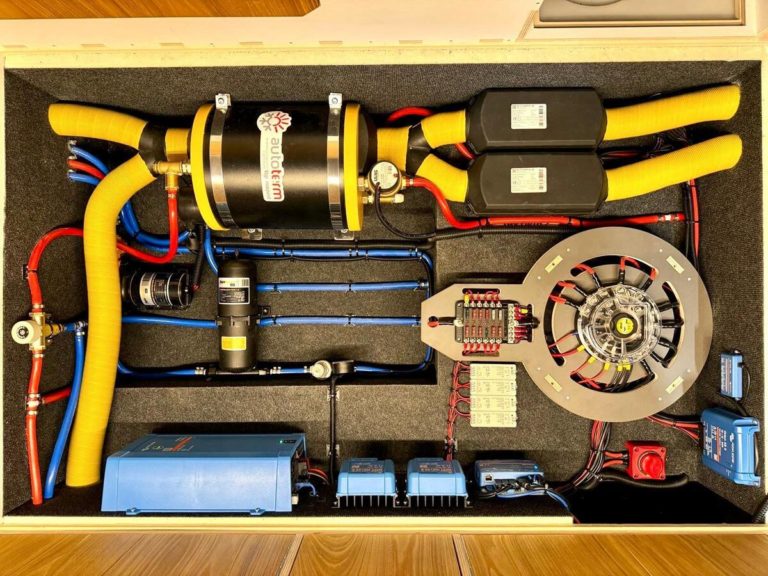
If you’re installing both heating and hot water from scratch, the Warmduscher-Kit 2.0 combines an Autoterm air heater, combiBOIL and Comfort Boiler Control in a matched package. If you already have a compatible Autoterm heater, the Warmduscher upgrade kit may be suitable. Before retrofitting, check compatibility with your specific heater and control panel.
One important planning detail: Comfort Boiler Control manages water heating through the air heater. The electric heating element and any connected coolant circuit each require their own specified temperature control.
Autoterm Baltica: for a system built around a hydronic heater
The Autoterm Baltica system is worth considering for conversions where a liquid-based heating circuit will provide the central heat supply. It combines an Autoterm Flow 5D hydronic heater with an expansion tank and a heat exchanger for hot water production. Depending on the installation, it can also provide cabin heating through water-to-air heat exchangers and be connected for engine preheating.
Choosing Baltica therefore means planning the heating system as a whole. If you want to use an air heater and mainly need to add hot water, a combiBOIL or Warmduscher-Kit is often the more straightforward option. If you want to distribute heat through a coolant circuit, a hydronic heating system is worth considering. Baltica’s 13-litre expansion tank contains coolant; its capacity is not equivalent to the usable hot water stored in a conventional water heater.
Water heater capacity and heating time: how much hot water do you need?
The storage tank capacity alone doesn’t tell you how much shower water will be available. Hot water from the heater is mixed with cold water to reach the desired temperature at the outlet. The usable quantity of mixed water therefore also depends on the stored water temperature, the cold water temperature and your preferred shower temperature.
Consider your shower head’s flow rate and how long you shower, too. A larger water heater provides more stored water, but takes up more space and requires more energy for the same temperature increase. With the same heating power, it also takes longer to heat up. Choose a capacity that matches your actual needs and your opportunities to reheat the water.
Electric heating: understanding power and energy demand
The heating element’s power rating mainly determines how quickly the water heats up. A lower-powered element places less demand on the electrical system at any one time, but takes longer to heat the same amount of water through the same temperature increase. The basic energy requirement remains similar, with heat losses and conversion losses adding to the total.
Plan electric water heating alongside your battery capacity, solar yield and other charging sources. This is also useful when combining several heating methods – for example, if you want to heat water electrically in summer when cabin heating isn’t needed.
Plan for connections, temperature and water pressure
The right water heater needs a matching installation. Check its permitted operating pressure and whether your water pump makes an additional pressure reducer necessary. A pressure relief valve protects against excessive pressure, while a thermostatic mixing valve blends in cold water to limit the temperature supplied to the hot water outlets and protect against scalding. These components perform different tasks and do not replace one another.
Temperatures directly at the water heater can be high, so use hoses and fittings rated for these conditions. Also allow for the approved mounting orientation, space around the connections and an accessible way to drain the unit. Before buying, compare what’s included: depending on the water heater or kit, temperature controls, safety components and connection materials may already be supplied or need to be added separately.