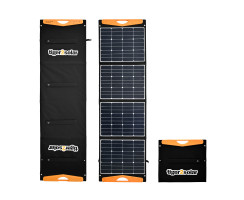
Solar panel series "black tiger" in various sizes
- please select to see specifications.
Motorhome Solar Panel: What You Should Consider Before Buying
In a motorhome, we need to generate as much energy as possible from the smallest possible area. Unlike a house, we don’t have a large roof surface available, while at the same time the electrical demands (and therefore power consumption) in travel vehicles are increasing. For this reason, solar panels designed for house roofs (and unfortunately all too often also for campers) are not particularly well suited for use on a motorhome.
To keep prices low and competitive, technical compromises are often made—for example (but not only) in the selection of the solar cells used. On the large surface area of a house roof, this still results in a decent amount of usable energy, and the issue usually receives little further attention.
In a motorhome, things are different. If we want to achieve a certain level of energy independence with solar power, every solar panel must be optimized without compromise. Cell efficiency, temperature coefficient, usable light spectrum—if all of these factors are taken into account, it makes a significant difference and can determine whether you can fully charge your laptop on the road or not—not to mention running an induction cooktop.
In addition to pure technical performance, other characteristics also play an important role in determining whether a panel is suitable for motorhome use. These include, for example, size and shape.
Solar panels are sensitive—cells can crack, leading to a loss of performance. When mounted on a vehicle roof that is constantly exposed to vibrations, potholes, thermal expansion and contraction, and possibly even slight torsion (as with expedition vehicle cabins), a panel with a side length of 2 meters can become problematic.
To reduce susceptibility to vibration, a motorhome solar panel should ideally have shorter edge lengths. Different formats also help to make better use of available roof space. Especially in vans, standard-sized panels often don’t fit well enough to utilize the available area efficiently. Space next to roof windows or ventilation domes is often considered unusable.
The “black tiger” motorhome solar panel was designed to address all of these points. It combines uncompromisingly optimized technology and is available in five special formats for reduced vibration sensitivity and optimal roof space utilization.
Motorhome Solar Panel “black tiger” – More Power Compared to Conventional Modules
Extremely High Efficiency
With cell efficiencies of up to 25%, our “black tiger” solar modules achieve top-tier performance in terms of energy yield per surface area.
High Open-Circuit Voltage
A high open-circuit voltage extends the time window for power generation, as both sunrise and sunset can be utilized more effectively.
For a single solar module, the advantage of a high open-circuit voltage can be significant. You can find more details on this somewhat complex topic in our article Series or Parallel Connection of a Solar System – What’s Better? in our online magazine.
Motorhome Solar Panel with Full-Surface Copper Layer on the Back
To achieve high reliability, we use a full-surface copper contact layer on the back instead of conventional copper connections (which are often suboptimally placed on the front). This offers two major advantages:
1. Less shaded surface area on the front, resulting in higher energy yield relative to module size.
2. Significantly greater reliability of the panel.
If individual cells in a module are damaged (microcracks, for example from branches or hail), conventional wiring often leads to a complete failure of the entire panel—the critical connections are interrupted, so even undamaged cells can no longer produce power. In contrast, the full-surface copper contact layer of the black tiger solar panels ensures the best possible power supply for your electrical consumers, even if individual cells or cell areas fail.
Improved Temperature Coefficient – Up to 25% MORE POWER Even in Heat
Manufacturer power ratings for solar panels are based on an ambient temperature of 25°C. The problem: as temperature rises, performance drops, because solar panels operate much less efficiently in heat. Now imagine how quickly 25°C is reached—or exceeded—on a motorhome roof. Performance decreases with every degree of temperature increase.
The “black tiger” motorhome solar panel counteracts this with special optimization. To minimize heat-related losses, they are equipped with high open-circuit voltage and low temperature coefficients (power loss per degree Celsius). For you, this means: up to 25% more energy yield compared to conventional solar panels at higher temperatures.
We’ve summarized more information on this topic in this article.
Wider Usable Light Spectrum
A solar panel can only convert a fraction of incoming light (within a specific frequency range) into energy. The “black tiger” solar panel is capable of utilizing a wider frequency range, meaning a broader light spectrum than usual. This includes the valuable final rays of sunlight during twilight, which can still be used to generate power for your camper’s electrical devices.
Wiring with Three Bypass Diodes
The special wiring of a black tiger solar panel includes three bypass diodes (except black tiger 100Wp). This ensures maximum performance under partial shading. Cells in sunlight are less affected by those in the shade.
Solar Panels in Special Sizes
To account for vibration, torsion, and thermal expansion on a motorhome roof, we deliberately design black tiger solar panels to be smaller than usual. The advantages are greater reliability and the ability to use areas next to roof windows or similar installations. With a width of just 30 cm, the “black tiger 80” fits easily next to hatches, ventilation domes, or roof boxes.
Framing and Covering
The “black tiger” solar panels are covered with special glass and framed in an elegant black aluminum frame.
Connecting a Motorhome Solar Panel
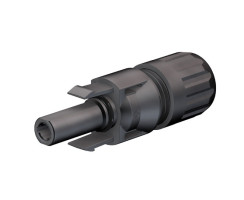
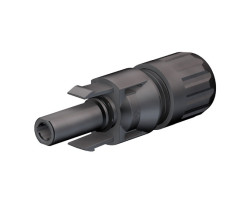
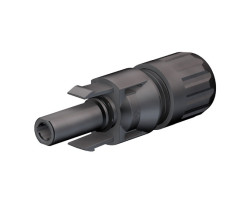
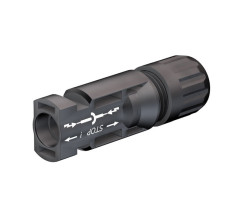
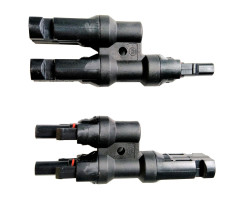
The connection is made on the back via pre-assembled cables—two cables, each 0.9 m long, with MC4 connectors.
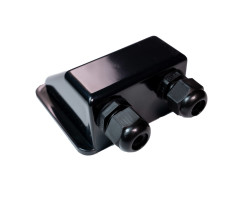
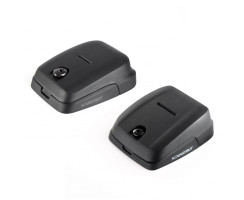
For a waterproof roof entry, we recommend either the multi cable gland or single (6–10 mm) and double horizontal cable glands (5–6 mm) from Scanstrut.
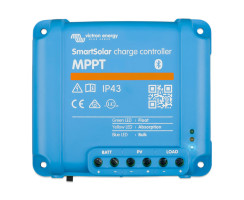
Solar Charge Controller
To connect the solar panel to the battery, a solar charge controller is always required. For the connection between the solar panel and the controller, you will also need solar cable of the appropriate length, an MC4 plug, and an MC4 connector (see our category Solar Installation Material).
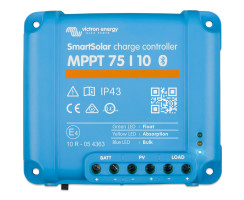
We recommend the SmartSolar controller from Victron Energy (please choose the appropriate size). If you want to connect multiple panels, a larger controller is required. You can determine the correct controller as follows:
The values of an MPPT 75/15, for example, mean a maximum panel open-circuit voltage (Voc) of 75V and a maximum charging current of 15A. The Voc value is listed in the panel datasheet, while the charging current must be calculated.
Example calculation:
The black tiger 100 has a Voc of 37.20V. This is less than 75V, so a controller rated for 75V is sufficient.
To calculate the charging current, divide the nominal power by 12.8V: 100Wp divided by 12.8V equals 7.81A. This is less than 10A, so the MPPT 75/10 controller is suitable for the black tiger 100.
A detailed explanation of how to calculate the correct charge controller can also be found in our online magazine, along with many other helpful articles about solar systems in motorhomes.
Not Sure About Components and Sizing?
Our technical advisors are happy to help. Together, we’ll assess your needs and design a system professionally tailored exactly to your requirements.
Simply request your non-binding and free consultation here.
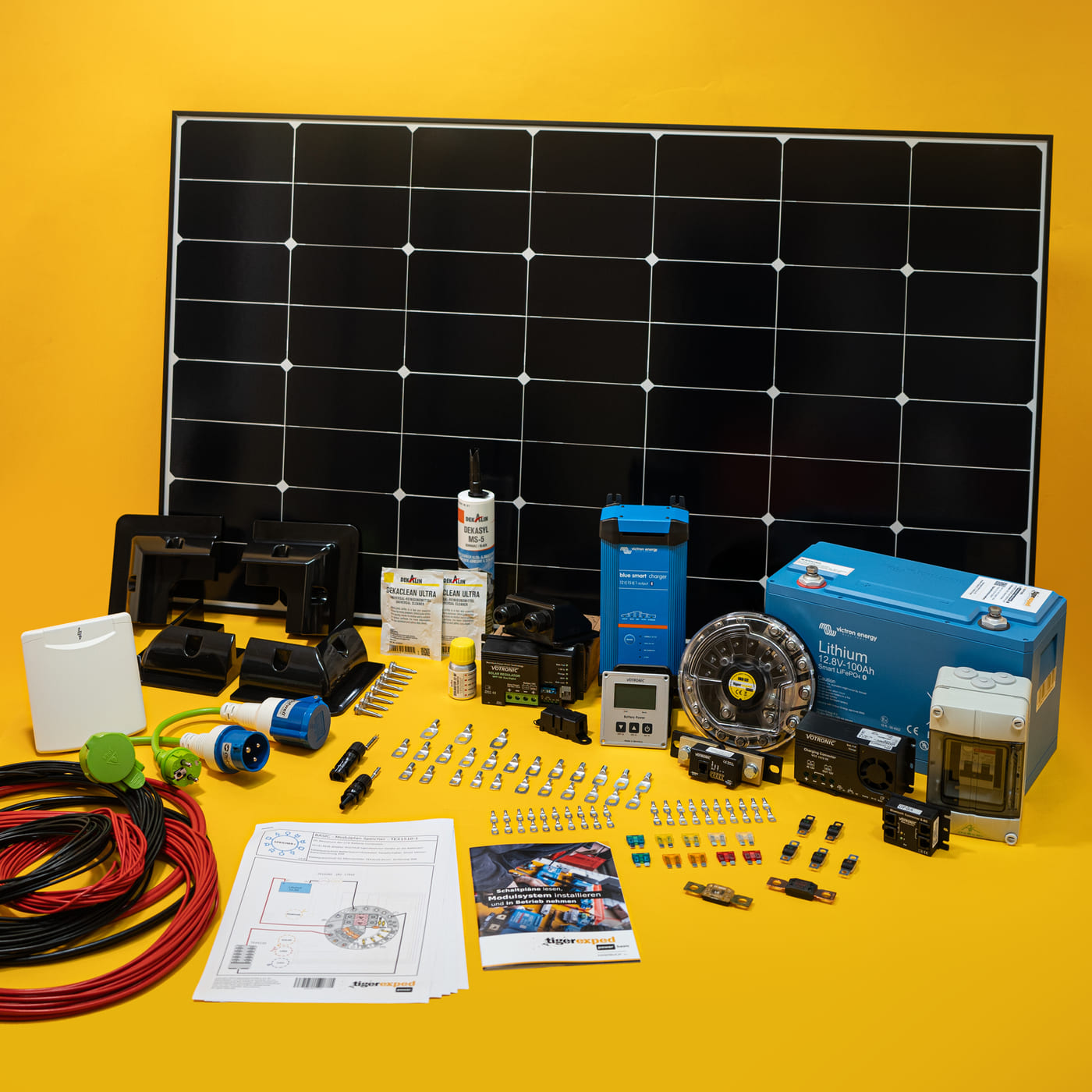
fix & fertig fachgerecht zusammengestellt
Hier ist direkt alles dabei, was du neben dem(n) Solarmodul(en) noch brauchst. Vergiss das mühevolle Zusammensuchen aller großen und kleinen Teile - einfach mit einem Klick auswählen, mit der mitgelieferten Einabuanleitung einbauen und los gehts!
Erhältlich von 1 x 100Wp bis 2 x 180 Wp.
manufacturer information:
texdev GmbH
Weseler Str. 82
Alpen, 46519
NRW, DE
info@texdev.de
responsible person:
texdev GmbH
Weseler Str. 82
Alpen, 46519
NRW, DE
info@texdev.de
Cells per module: |
4 x 14 |
Power tolerance: |
+/- 3% |
Open circuit voltage: |
40,84 Voc |
Nominal voltage: |
34,7V |
voltage temperature coefficient: |
-0 .236%/°C |
Current temperature coefficient: |
-0 .058%/K |
Power temperature coefficient: |
-0 .27%/K |
Cell efficiency: |
24,40 % |
Operating temperature: |
-40 to +85°C |
Max system voltage: |
600VDC |
bypass diodes: |
2 |
Open circuit current: |
3,05 Asc |
max. power: |
100Wp |
Amperage: |
2,88A |
Item weight: |
5,90 kg |
|
Dimensions packing
( l × w × h ):
|
95,50 × 54,00 × 3,50 cm |
All reviews: