Lithium Batteries (LiFePo4)

Lithium Batteries (LiFePo4)
LiFePO4 batteries provide safe, long-lasting power for the appliances in your camper van or motorhome. When choosing a battery, look beyond capacity: check its discharge current rating and consider whether you need features such as battery heating or Bluetooth.
Which LiFePO4 battery is right for your camper van?
The right leisure battery stores enough energy for your trip and can power your appliances simultaneously. These are two different requirements: capacity determines how much energy is available, while the discharge current rating helps determine which appliances you can run. Also check which system voltage and battery dimensions suit your conversion.
System voltage and installation space: What fits your vehicle?
The battery’s nominal voltage must match your electrical system. A LiFePO4 battery rated at 12.8 V is intended for a compatible 12 V system. To use these batteries in a 24 V system, they must be explicitly approved for connection in series.
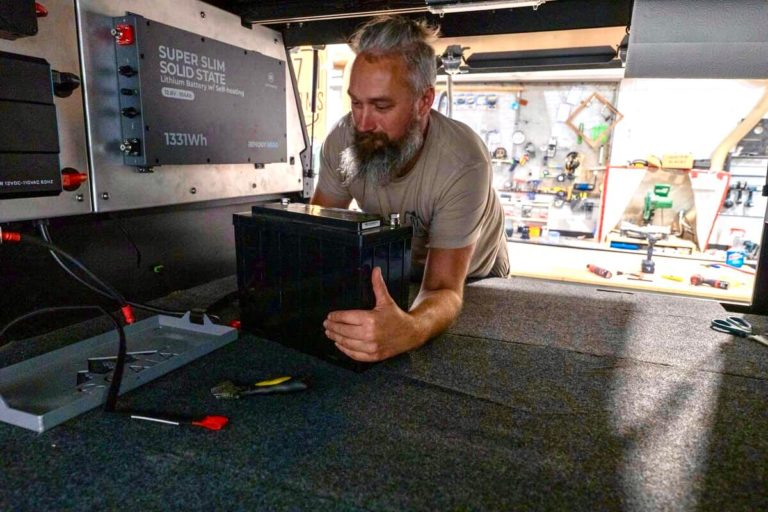
Measure the installation space before buying. Alongside length, width and height, allow room for terminals, cables and secure mounting. For an underseat battery, the exact seat base and any equipment already fitted are particularly important. The term “underseat battery” alone does not guarantee that a model will fit your vehicle. Check the permitted mounting orientations as well.
Capacity: How much energy do you need between charges?
Capacity in amp-hours (Ah) helps you compare batteries with the same nominal voltage. When comparing different voltages, energy in watt-hours (Wh) is more useful: nominal voltage multiplied by amp-hours gives the battery’s nominal stored energy. For example, a 12.8 V, 100 Ah battery stores a nominal 1,280 Wh. The energy you can actually use depends on factors including operating conditions, discharge limits and system losses.
The capacity you need depends on both your daily consumption and the time until your next charge. Regular driving or reliable access to mains hook-up creates different conditions from staying in one spot for several days. Solar can help you stay off-grid for longer, but its contribution varies with the season, weather and location.
Allow a reserve and consider your battery and charging options together. Our Autarkie-Designer Pro lets you simulate appliance use, driving distances and time spent parked up for your trip, helping you assess your energy needs.
Discharge current: Can the battery power your appliances?
A high Ah rating does not automatically mean that a battery can deliver high currents. If you want to use an inverter to power a coffee machine, kettle or induction hob, the maximum continuous discharge current is particularly important. The battery, battery management system and electrical installation must support the appliances you intend to run simultaneously.
For perspective, a 2,000 W appliance powered through an inverter from a battery at 12.8 V would theoretically draw around 156 A before inverter losses. The actual current will be higher and increases further as battery voltage drops. Other appliances running at the same time add to the demand. A short-term peak rating therefore cannot replace an adequate continuous discharge rating.
Battery heating: useful for cold destinations and installation spaces
LiFePO4 batteries have different temperature limits for charging and discharging. Being able to supply power in cold conditions does not mean that a battery can also be charged at the same temperature. Cell temperature and the limits specified for the individual model are what matter.
An integrated heater can warm the cells to the required temperature before charging starts. This is particularly useful if your battery is installed in a cold location or you travel in winter. Check how the heater is powered and how much charging power it needs to operate. A heated battery cannot necessarily begin charging immediately in all cold-weather conditions.
BMS, Bluetooth and system monitoring: Which features do you need?
The battery management system (BMS) monitors the cells and, depending on its functions, protects them against conditions such as voltages, currents or temperatures outside the permitted limits. Check whether the BMS is integrated or needs to be added separately as part of the battery system. A BMS does not replace correctly specified fuses and a properly designed electrical installation.
Bluetooth is useful if you want to check battery data directly on your phone. The information available varies by model. Depending on your setup, central monitoring may also use a shunt-based battery monitor or communication interfaces. If you want to connect the battery to an existing monitoring system, check specific compatibility: a CAN bus connection alone does not guarantee it.
LiFePO4 or Solid State: What should you compare?
The batteries described as Solid State in our range also use lithium iron phosphate technology. The relevant semi-solid-state models contain a reduced proportion of liquid electrolyte, which is one of many possible safety features. However, the practical specifications remain essential when choosing: stored energy, current ratings, dimensions, temperature limits and system compatibility. The technology label alone does not tell you which battery is best for your conversion.
Replacing an existing battery or planning future expansion?
If you are switching from a lead-acid or AGM battery to LiFePO4, check your existing charging equipment too. Your mains charger, solar charge controller and alternator charging setup must meet the new battery’s charging requirements and current limits. Matching nominal voltage and dimensions alone does not guarantee a straightforward replacement.
If you want to combine several batteries, check whether parallel or series connections are explicitly permitted and how many batteries may be connected. Combining different models or batteries of different ages also requires checking. If you expect to expand your battery bank later, factor this into your initial choice.
What to compare before buying
- Voltage and dimensions: Is the battery electrically compatible, and does it fit your installation space?
- Capacity: Does it provide enough usable energy for your planned time between charges, with a sensible reserve?
- Continuous and peak discharge current: Can it supply your appliances and handle their startup demands?
- Charging and temperature: Do your chargers, the permitted charging currents and the temperature limits suit your use?
- Features and expandability: Do you need heating, Bluetooth, system communication or the option to connect several batteries?