
Error 1 on Autoterm / Planar auxiliary heaters
What does Error 1 mean
Error 1 means the heater is getting too hot. The reason: the heater produces heat but can't carry it away fast enough. In 99 % of cases this is down to air ducting that is too long, too narrow or has too many bends.
How to check this
A first check is very simple. First, the entire air ducting on the warm-air side of the heater should simply be removed. If it then runs, you know the problem lies there.
Defective temperature sensor
If the temperature sensor measures wrong (too high) values, it could of course also happen that the heater switches off because of overheating. Such a sensor can also be broken, but in that case it is Error 7 and is displayed accordingly.
In practice a defective temperature sensor is extremely rare - we have almost never seen Error 7. It can't be ruled out, but Error 7 also shows that the heater notices when the sensor displays nonsense. The search for the cause of Error 1 should therefore focus on the air ducting and not on the temperature sensor.
Interim conclusion on the cause
Overheating with Error 1 is therefore almost 100 % down to the air ducting connected to the heater. Ducting that is too long overall, with too many bends or reductions in the duct cross-section, results in a heat build-up that the heater eventually can't do anything about.
Keep it simple is the motto here. The heater would prefer to have no ducting at all.
Why Error 1 hardly occurs anymore today
In recent years Autoterm has taken a number of measures to help the user, and as a result Error 1 has become very rare.
However, the manufacturer did not do this to make unfavorable air ducting layouts possible! The intention is rather to make "survival" possible for the user in an emergency - that is, the heater does not mercilessly switch off on freezing cold nights.
Just imagine a Russian truck driver whose sock half falls in front of the heater - with the heat build-up this causes, the heater does not simply switch off but reduces its output enough to keep operating.
This should not become a permanent state, because the combustion chamber no longer gets properly hot, but at least you survive that night.
How do I notice that my heater is reducing its output
1. Fan operation
If you have had no contact or experience with such a heater, the assessment can be a bit difficult. But once you have seen a heater that runs normally and can breathe freely, you will notice a very even motor or fan sound.
If the heater gets too hot, whether because it is drawing in its own warm air again, is struggling with air ducting that is too narrow, or because a sock is lying in front of it, the heater will try to reduce its output enough to keep operating. You can notice this reduction. First of all, of course, at the moment the output reduction takes place, but also when, for example, you wake up at night and the heater makes a whimpering noise. The speed drops a little and rises a little again, over and over. If the speed fluctuates like this, that is the emergency mode in which the heater is trying to somehow stay on. Of course you don't want to have this state (emergency mode) permanently.
Here you really have to go looking and find the cause so that the heater can run cleanly.
2. Intake air temperature
As already discussed, it is not easy, especially for new heater owners, to tell from the fan operation whether the heater is currently in output reduction mode. However, there is a second indicator that is very easy to check.
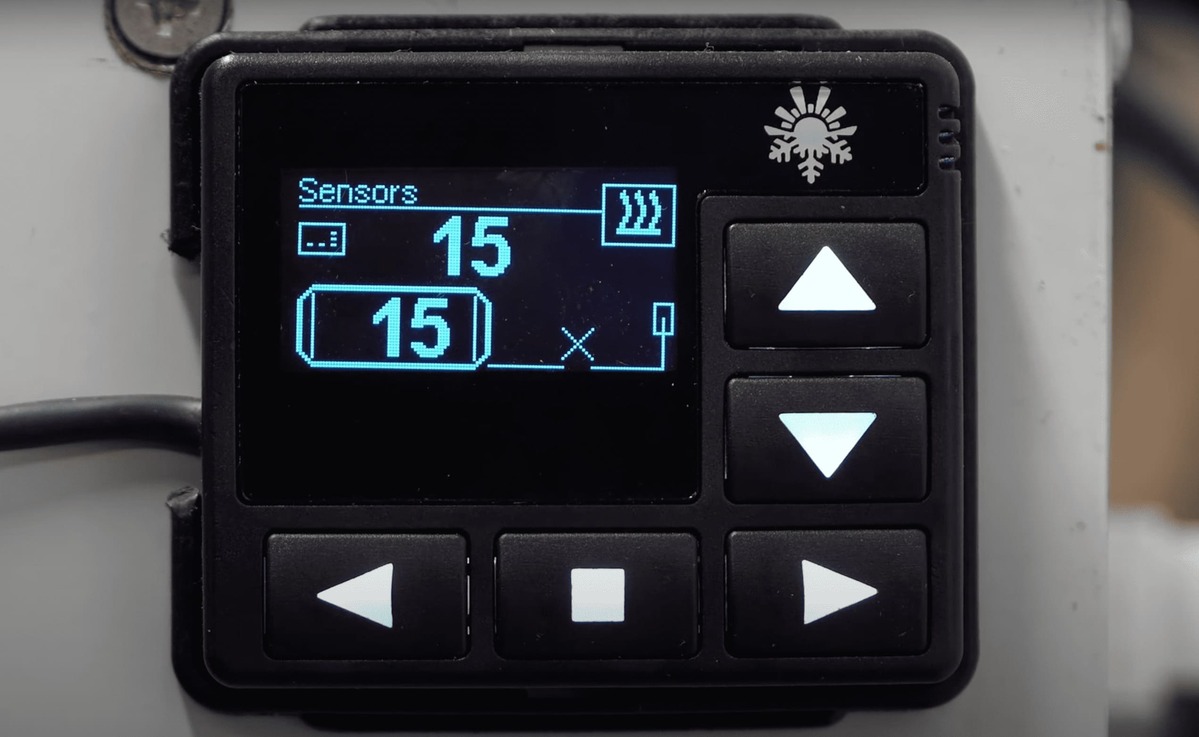
The heater has a sensor on the main board that monitors the intake air temperature. The air flow that the fan wheel pushes through the heater can therefore be measured, for example in the PU-27 control panel (as seen in our video) but also in other control panels, and displayed as "t-heater" (see the operating manual).
As a rule of thumb: if a temperature above 30 degrees appears here, the heater will definitely try to reduce its output and go into emergency mode. You have probably not made an optimal installation, or (unlikely) the sensor is broken.
If the displayed temperature rises above 35 degrees, the heater will build in cooling phases, that is, switch off without displaying an error and start up again after some time.
Conclusion
Watch the intake air temperature. If the heater, for example because of how the warm-air ducting is routed, draws its heated air straight back in, this value becomes too high, the heater will reduce its output and we get an email with the subject: "The heater doesn't heat". You can check the value in the control panel.
Can't find the fault?
If you have checked your system against the points mentioned but can't find the problem, feel free to contact one of our installation partners. That way the installation can be inspected directly in the vehicle. You can find the list of our installation partners here