
Error 13 on the Autoterm Auxiliary Heater
Error 13 is the most frequently occurring error code on auxiliary heaters from the manufacturer Autoterm - many people also know them under the product names Planar 2D or Planar 44D. Often it is not a real fault at all, because after the initial installation of the heater, for example, Error 13 appearing several times is completely normal and no cause for concern.
What does Error 13 mean
When someone asks us why the heater shows Error 13, we always say: It's out of fuel. What it actually means is something quite different, though: within the number of automatic start attempts the heater makes, a start was not possible.
That means the heater makes a start attempt after the button is pressed. If that fails, it will automatically try a second time after a short while. Only when the second attempt is also unsuccessful is Error 13 displayed.
So why do we say "It's out of fuel"
Almost all components of the heater can be monitored and diagnosed, e.g. via sensors. Whether the fuel pump can't be detected electrically, the glow plug is broken, the fan is blocked or there is a problem with the power supply - all of that can be determined by measuring.
It's different when, for example, a combustion chamber is completely sooted up or has a hole. Unfortunately that component can't be monitored e.g. by camera, which means a problem at this point would only show up as the heater not starting.
In our experience, Error 13 should first be seen as a fuel problem. In 99 % of cases there is no fuel - it never arrives in the first place. Whether that is the case is easy to check.
If fuel were arriving
If fuel were injected into the combustion chamber but the heater did not start, part of it would still be vaporized by the glow plug and blown out as white smoke. During the start phase this makes the exhaust smoke like crazy.
Such heavy smoke with a heater that won't start is therefore the main indicator of, for example, a completely sooted-up combustion chamber, where the glow plug or the flame screen may also already be covered in thick deposits. With every further start attempt more and more diesel is injected that doesn't burn, and at some point the sludge even runs out of the exhaust, because all that fuel has to go somewhere.
This is one of the possible causes of Error 13.
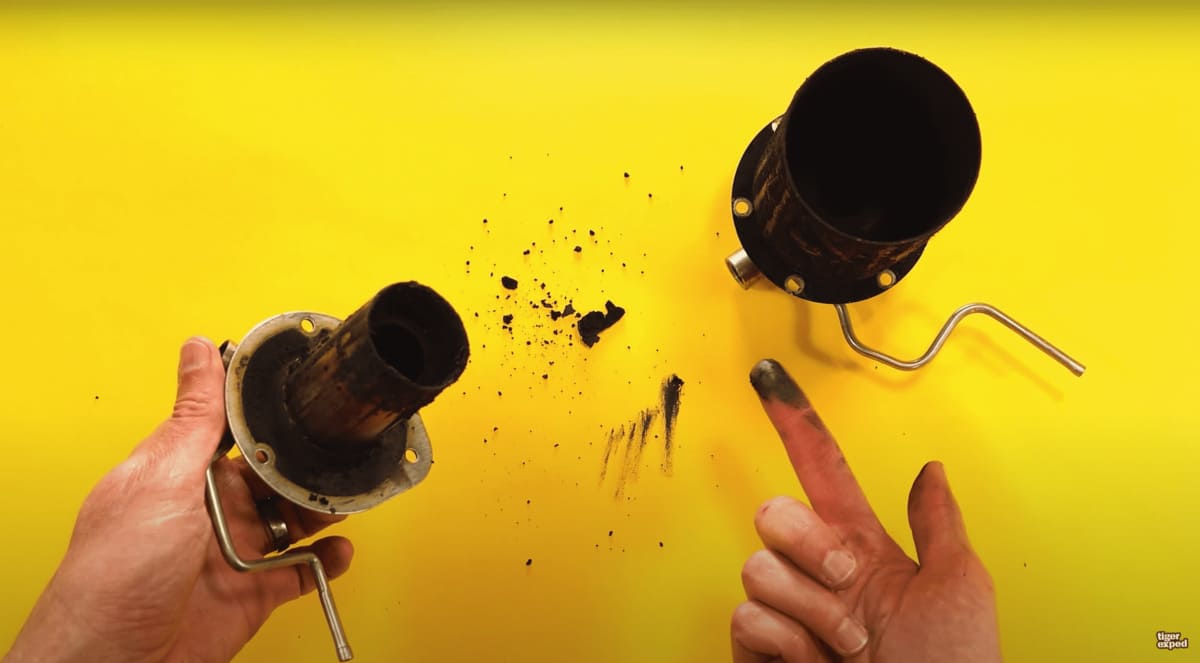
Our picture shows two good examples of sooted-up combustion chambers. Here we have the combustion chamber of a Planar 2D and of a 44D heater, both of which failed with Error 13 and were sent back to us.
Both combustion chambers have thick, black soot deposits which, together with the unburned diesel, form a greasy mass.
What the soot does
The soot causes two things: first, it insulates. An insulating layer forms over the entire surface of the combustion chamber, so that the heat of the fire can no longer pass to the heat exchanger on the outside and thus to the room air. In principle you are lighting a fire for nothing. In this case you notice, even before Error 13, how the heating output gets worse and worse over a longer period.
As a rule, the combustion chambers can no longer be cleaned and repaired properly - with a lot of patience you can soak them in white spirit and try to pick everything out, but it is very laborious work.
Second, the soot leaves less and less glowing metal on which ignition can take place. And that is also the reason why the heater eventually simply can't start anymore: you drip the diesel onto a cold, insulating layer of soot, and there is no longer enough heat to start the heater, i.e. to ignite the diesel.
Error 13 is thus a very popular game - not so popular in our workshop, because in the end it is not only the combustion chamber that is covered in soot, but also our technician Daan in the workshop.
Error 13: the fuel never arrives
Much more often than from diesel that cannot be ignited, Error 13 is caused by diesel that never reaches the heater in the first place. Unlike Error 13 WITH diesel, you can easily recognize this variant by the fact that almost no smoke comes out during the start phase. If there are heavy deposits, you can of course still see a little smoke, because the glow plug heats up and vaporizes a small part of the diesel from the greasy mass - but the big clouds of smoke fail to appear.
If no diesel arrives, nothing happens. No fuel arrives, and after two start attempts the heater gives up. In 99 % of all Error 13 messages, the cause is a lack of fuel.
Is the fuel pump to blame?
If the fuel pump were defective, a different error would be displayed (see Error 17). Listening briefly will also tell you that the pump clicks.
So why is no fuel arriving?
Of course it may be that the pump is drawing air instead of diesel because the tank is too empty. The pickup does not reach down to the bottom of the tank, so that the last diesel, which is still needed to start and to reach the next gas station, is not used up by the heater.
Air can also be drawn in through a leaking connection or similar. So check the fuel supply if there is air in the line.
Error 13 after Error 78
If Error 13 appears on a heater that is fully installed and has already been running, it is often the consequence of Error 78. 78 is not a real error, but a notice from the heater that is displayed only while it is being switched off.
Error 78 means that at some point during operation of the heater a flame-out occurred. That is, there was no fuel for a very short moment, but fuel followed quickly enough for the heater to keep running. So it only just managed to get over the hump and did not go out - the night did not get cold. When switching it off in the morning, however, you get the notice: "78 - something was off with the fuel last night, please keep an eye on the fuel supply".
If the heater was run until the tank was empty, i.e. air was sucked into the lines, the cause is easy to imagine. If that is not the case and 78 simply appears during normal operation, then there is 100 % something wrong with the fuel supply. If you don't take care of it, Error 13 will soon follow and the night gets cold. 13 means the air bubble was so large that the remaining diesel was not enough to keep the heater running.
Error 13 during the initial installation of the heater
If a diesel auxiliary heater has been newly installed, Error 13 appearing at the first start is completely normal. The new fuel lines are still empty and therefore full of air, which first has to get out. Until enough diesel has been delivered by the pump, a few start attempts are necessary (depending on the length of the line). So with a new installation, don't let Error 13 worry you: after a few attempts the lines will be filled with diesel and the heater will start. In future the fuel is already in the line, waiting to be used, and the heater starts without Error 13.
You're not sure where the fault is / does the combustion chamber need replacing?
If you strongly suspect that your combustion chamber might be completely sooted up, or you are not sure where the fault is, you can register your heater with us for repair using the form attached below. Of course you can also hire one of our installation partners to help with troubleshooting directly on the vehicle if you can't get any further yourself. You will find the list of our professional installation partners to contact here.
All error codes on Autoterm Air / Planar auxiliary heaters
(Blink codes = control panel PU-5)